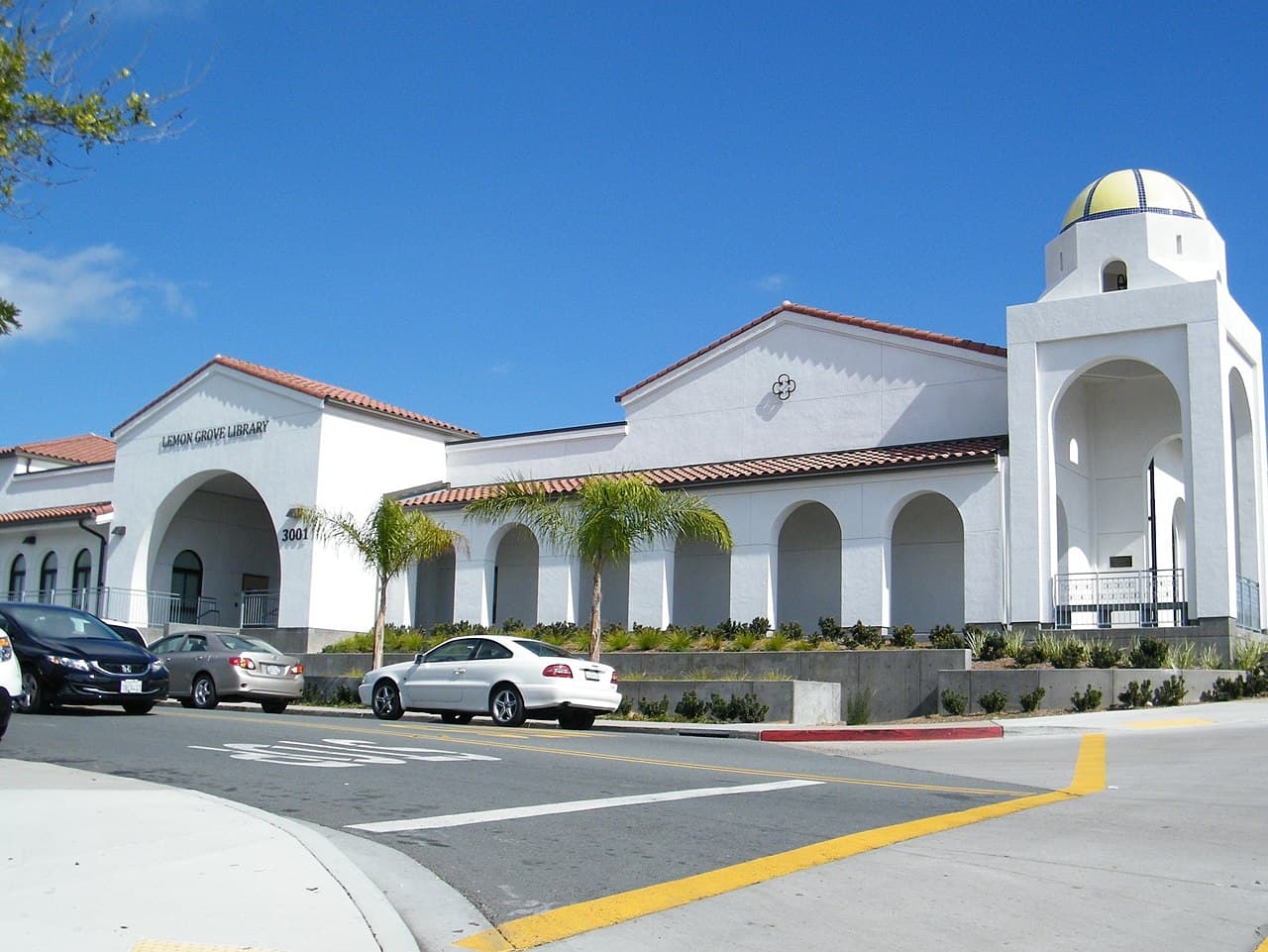
Lemon Grove
Best Climate on Earth
Small city with historic charm, the famous giant lemon statue, and affordable single-family homes with easy trolley access.
Lemon Grove Market Snapshot
Last updated: Q1 2026
$720K
Single family
N/A
Condo / townhome
28
Days listed
+5%
Price change
Want the full Lemon Grove market report?
Get detailed stats on inventory, price trends, and forecasts delivered to your inbox.
Request Market ReportQuick Facts
- ZIP Codes
- 91945, 91946
- School District
- Lemon Grove School District / Grossmont Union
- Walk Score
- 40/100
- Bike Score
- 35/100
- Coordinates
- 32.7426, -117.0314
Why Lemon Grove?
- The World's Largest Lemon — iconic 10-foot landmark
- Trolley Orange Line to downtown San Diego
- Affordable single-family homes with character
- Historic Main Street with local businesses
- Strong community identity and neighborhood pride
Get the Lemon Grove Market Report
Median prices, inventory trends, days on market, and price forecasts for Lemon Grove — delivered to your inbox monthly.
Be First to See New Lemon Grove Listings
Get notified the moment a new home hits the market in Lemon Grove. Many of the best properties sell within days — don't miss out.
Lemon Grove might be the most underestimated city in San Diego County. At just 3.8 square miles, it is tiny — smaller than most master-planned communities. It is sandwiched between La Mesa to the north, Spring Valley to the east, and the city of San Diego to the west and south. It has a giant lemon statue on Main Street. And it is, right now, one of the smartest places to buy a home in the San Diego metropolitan area if you understand what you are looking at.
What you are looking at is this: a small, fully urbanized city with direct trolley access to downtown San Diego, housing stock that is priced $150K-$250K below comparable neighborhoods to the north and west, and a community that is early in a cycle of investment and improvement that has already transformed places like North Park, Golden Hill, and City Heights. Lemon Grove is not there yet. But the bones are right, the transit infrastructure is in place, and the price of entry is the lowest you will find anywhere in urban San Diego.
The MTS Orange Line Trolley is the anchor of the value proposition. Lemon Grove has two trolley stations — Lemon Grove Depot on Main Street and Massachusetts Avenue station on the east side of town. The Orange Line runs directly to downtown San Diego with a travel time of approximately 25 minutes from Lemon Grove Depot to 12th and Imperial, where you can transfer to the Blue and Green lines for access to the rest of the system. That 25-minute direct connection to downtown, at $2.50 per ride, is competitive with or faster than driving during peak hours — and you never have to worry about parking. For anyone working downtown, in the East Village, at Petco Park, or in the Civic Center area, the trolley commute from Lemon Grove is legitimately excellent.
The housing stock is overwhelmingly single-family homes built between the 1940s and the 1970s. This is post-war and mid-century California tract housing — stucco ranch homes, some with brick facades, flat or low-pitched roofs, and floor plans of 900 to 1,500 square feet. Most sit on lots of 5,000 to 8,000 square feet, many with detached garages and space for ADU construction. The homes along Broadway between Main Street and Massachusetts Avenue represent the most established residential corridor. Federal Boulevard, Central Avenue, and the streets climbing the hills north of Main Street toward the La Mesa border — Golden Avenue, Marigold Way, Lemon Grove Avenue — offer slightly higher elevation, occasional views, and marginally larger lots. The southern portion of the city, near Encanto and the 94 freeway, tends to be more affordable but less desirable.
Pricing is Lemon Grove's headline feature. The median home price sits around $600K — and that is for a detached, single-family home with a yard and a garage in an urban location with trolley access. Try finding that combination anywhere west of the I-15 corridor. Updated homes with modern kitchens, new systems, and curb appeal push to $650K-$725K. Unrenovated homes that need work — and there are many — can still be found from $500K to $575K. The renovation opportunity here is real and specific: a buyer can purchase a home that needs $50K-$100K in renovations, invest in modernization, and end up with an updated home at a total cost that is still below the median in La Mesa, Del Cerro, or San Carlos. I have walked multiple clients through this exact process in Lemon Grove, and the math works every time.
The downtown core along Main Street is modest but has character. The giant lemon — a fiberglass sculpture that has been a local landmark since 1928, later replaced and now maintained as a community icon — sits at the corner of Broadway and Main Street. It is kitschy and endearing, and residents embrace it with genuine affection. The Main Street corridor has a small mix of restaurants, shops, and services. Cocina de Barrio serves solid Mexican food. The Lemon Grove Deli and Bakery is a longstanding local spot. The weekly Lemon Grove Community Market brings vendors and neighbors together. This is not a destination dining scene — it is a neighborhood commercial district that serves daily needs and hosts community gathering.
Schools are served by the Lemon Grove School District for elementary and middle school, and the Grossmont Union High School District for high school. Lemon Grove Academy, the local elementary school, has been the focus of improvement efforts, and test scores have been trending upward. Mount Vernon Elementary and San Miguel Elementary serve other portions of the district. For high school, students attend either Helix High School or Mount Miguel High School, both in neighboring communities. Helix, in La Mesa, has a strong reputation — particularly its performing arts program and its charter school within a school. Mount Miguel, in Spring Valley, is more mixed in its performance. The specific high school assignment depends on your address within Lemon Grove, so buyers with school-age children should verify boundary assignments before making offers.
The community is diverse and working-class, with growing pockets of young families and first-time buyers who are drawn by the value proposition. The demographics are shifting — slowly, and not without tension — as affordability draws buyers from pricier neighborhoods to the west. This is a community in transition, and that transition creates both opportunity and complexity. Long-time residents have deep roots and strong opinions about development and change. The City Council has been navigating between encouraging investment and preserving affordability, a balance that every gentrifying neighborhood must strike.
Commute times beyond the trolley: driving to downtown is 15-20 minutes via I-94 West or I-8 West. La Mesa is five minutes north. SDSU is 10 minutes west. Getting to UTC and Sorrento Valley takes 20-30 minutes via I-8 West to I-805 North or I-15 North. The I-94 freeway provides quick east-west access, and I-8 is just north via the La Mesa on-ramps. For a community this affordable, the transit and freeway access is remarkably good.
Recreation is adequate without being exceptional. The city has several small parks — Berry Street Park, the Lemon Grove Recreation Center on School Lane, and a skate park that draws neighborhood kids. For serious outdoor recreation, Mission Trails Regional Park is about a 10-minute drive north, and Lake Murray is similarly close. The proximity to La Mesa's parks and trails — including the Lake Murray path — means that Lemon Grove residents have access to excellent outdoor resources even though the city itself is too small and urbanized to have major parks within its boundaries.
Market snapshot: appreciation has been running at 6-8% annually, outpacing several more expensive neighborhoods in percentage terms. The absolute dollar appreciation is more modest — a 7% gain on a $600K home is $42K, compared to 5% on a $1M La Mesa home yielding $50K — but for the buyer investing less capital, the percentage return matters. The rental market is strong: single-family homes rent for $2,200-$2,800 per month, and homes with ADUs can generate $3,500-$4,500 in combined rental income. Vacancy rates are among the lowest in the county.
Who should buy here: Lemon Grove is ideal for first-time buyers who want homeownership — real homeownership, not a condo — at an entry point that is achievable on a median San Diego income. It suits buyers who are willing to put sweat equity into a property. It works well for trolley commuters who work downtown and want a short, predictable transit commute. It attracts investors who see the value in purchasing affordable homes, adding ADUs, and building rental income. And it appeals to anyone who watched North Park or Normal Heights transform over the past 15 years and recognizes the early signs of the same trajectory.
Insider tips: the homes on the hills north of Main Street, particularly along Lemon Grove Avenue and Washington Street approaching the La Mesa border, are the most desirable in the city — slightly higher elevation, quieter streets, and functionally closer to La Mesa's amenities while maintaining Lemon Grove pricing. For renovation candidates, focus on the homes along Broadway and Federal Boulevard that have good bones but outdated finishes — these homes were well-built in the 1950s and 1960s and respond beautifully to kitchen, bathroom, and systems upgrades. The lots near the Lemon Grove Depot trolley station have the strongest long-term appreciation potential as transit-oriented development becomes increasingly valuable in San Diego's evolving transportation landscape.
Potential downsides: parts of Lemon Grove have higher crime rates than neighboring La Mesa, and block-by-block research is essential. The housing stock is old, and many homes have deferred maintenance that goes beyond cosmetic — galvanized plumbing, outdated electrical panels, and foundation issues are common in the older homes and must be accounted for in your budget. The commercial corridors are not attractive — there is no Main Street charm comparable to La Mesa Village, and the strip-mall aesthetic along Broadway can feel tired. Some blocks have a higher concentration of rental properties with absentee landlords, which affects neighborhood upkeep. And the "Lemon Grove" address carries a stigma in the minds of some San Diego buyers that is not entirely fair but is real in terms of resale perception. This is changing, and it will continue to change, but buyers should understand that they are buying ahead of the curve, not at the peak of a transformation. That is where the opportunity lives, and it is also where the risk lives.
Lemon Grove Neighborhood Tour
We're producing a walking/driving tour video for Lemon Grove. Subscribe to be notified when it's ready.
Notify Me When ReadyNearby Attractions
Frequently Asked Questions
What is the median home price in Lemon Grove?
As of Q1 2026, the median single-family home price in Lemon Grove is approximately $720,000. Prices are up about 5% year-over-year.
Does Lemon Grove have public transit?
Yes. The Orange Line Trolley runs through Lemon Grove with a station on Main Street, providing direct access to downtown San Diego, El Cajon, and connecting transit lines.