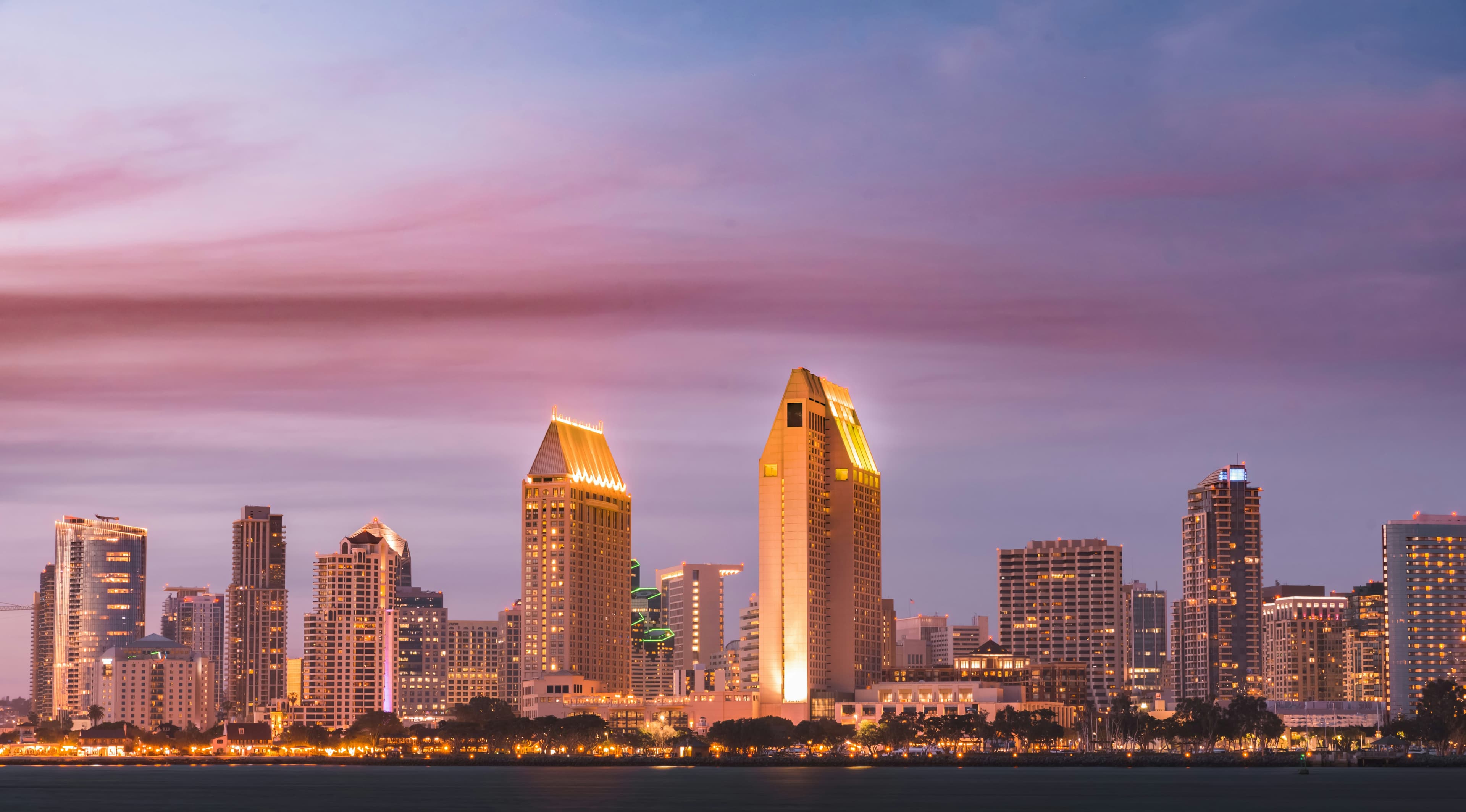
Downtown San Diego
Urban Living at Its Finest
The Gaslamp Quarter, East Village, Little Italy, and the waterfront — downtown offers walkable urban living with world-class dining and entertainment.
Downtown San Diego Market Snapshot
Last updated: Q1 2026
$650K
Single family
$580K
Condo / townhome
35
Days listed
-2%
Price change
Want the full Downtown San Diego market report?
Get detailed stats on inventory, price trends, and forecasts delivered to your inbox.
Request Market ReportQuick Facts
- ZIP Codes
- 92101, 92102
- School District
- San Diego Unified
- Walk Score
- 95/100
- Bike Score
- 88/100
- Coordinates
- 32.7157, -117.1611
Why Downtown San Diego?
- Gaslamp Quarter — restaurants, bars, and nightlife
- Little Italy — San Diego's best dining neighborhood
- Petco Park and East Village entertainment district
- San Diego Convention Center and waterfront
- Highest walkability in San Diego County (Walk Score 95)
- Multiple trolley lines and transit connections
Get the Downtown San Diego Market Report
Median prices, inventory trends, days on market, and price forecasts for Downtown San Diego — delivered to your inbox monthly.
Be First to See New Downtown San Diego Listings
Get notified the moment a new home hits the market in Downtown San Diego. Many of the best properties sell within days — don't miss out.
Downtown San Diego is not one neighborhood. It is five or six distinct neighborhoods compressed into roughly one square mile, each with its own character, price point, and lifestyle proposition. Buying downtown means choosing which version of urban living you want, and getting that choice right is the difference between loving your life and regretting your purchase. I sell a lot of downtown condos, and the single most important thing I tell buyers is this: do not buy a neighborhood, buy a building, and do not buy a building until you have read every page of the HOA documents, understood the reserve fund, and asked about special assessments. This is where downtown dreams go to die if you skip your homework.
Little Italy is the crown jewel. Bounded roughly by Laurel Street to the north, Ash Street to the south, the waterfront to the west, and State Street to the east, Little Italy has the best restaurant density of any neighborhood in San Diego — and arguably the best in Southern California outside of certain Los Angeles pockets. India Street is the spine, and the restaurants along it and the surrounding blocks are world-class. Kettner Exchange on Kettner Boulevard offers inventive New American cuisine. Juniper and Ivy, from Top Chef winner Richard Blais, brings creative fine dining. Extraordinary Desserts is exactly what the name promises. Craft and Commerce serves cocktails in a space that defined the modern speakeasy revival in San Diego. Ballast Point Brewing's Little Italy tasting room, Bencotto for handmade pasta, Civico 1845 for Sicilian cuisine, and the Little Italy Food Hall with its rotating vendor stalls create a dining ecosystem that is deep enough to eat out every night for a month without repeating. The Little Italy Mercato, a Saturday morning farmers market on Date Street, is the best farmers market in the city — full stop. Living in Little Italy means walking to everything: restaurants, coffee shops, the waterfront at the County Administration Center, the Little Italy trolley station, and the growing number of boutiques and galleries. The condo buildings here are mostly mid-rise and high-rise construction from the 2000s through the 2020s. Bayside at the Embarcadero and Pacific Gate by Bosa are the luxury flagships, with units starting above $1M and penthouses in the multiple millions. More accessible options include buildings like Acqua Vista, Brickyard, and Aperture, where one-bedroom units price from $475K to $600K and two-bedrooms from $650K to $900K. Little Italy is the most expensive submarket downtown, and the premium is justified by the walkability and dining scene.
The Gaslamp Quarter, running along Fifth Avenue from Broadway to Harbor Drive, is downtown's nightlife and entertainment district. This is where visitors go — the bars, the clubs, the chain restaurants mixed with local spots. For residents, the Gaslamp has a specific appeal and a specific drawback: the energy is unmatched on weekend nights, and the noise is unmatched on weekend nights. Buildings like the Lofts at 655 Sixth, Icon, and The Legend offer condo living in the heart of the action. One-bedroom units price from $400K to $550K, two-bedrooms from $550K to $750K. The Gaslamp works best for younger buyers who want to be in the thick of it, or investors targeting the short-term rental market — though city regulations on short-term rentals have tightened significantly, so verify current rules before building an investment thesis around Airbnb income.
East Village is the value play and the neighborhood with the most room to grow. Stretching east from Park Boulevard toward the I-5 corridor, East Village is anchored by Petco Park, home of the San Diego Padres. Game days bring enormous energy — the blocks around the ballpark come alive 81 times a year, and the restaurants and bars within walking distance (Lolita's Taco Shop on Park Boulevard, Bub's at the Ballpark, Resident Brewing Company) thrive on the foot traffic. But East Village is more than baseball. The neighborhood has attracted significant development over the past decade, including Makers Quarter, a mixed-use district along 15th Street with co-working spaces, breweries like Fall Brewing Company, and a growing creative-economy cluster. IDEA1 and Shift are newer residential buildings with modern amenities targeting younger professionals. The pricing is noticeably lower than Little Italy: one-bedroom condos from $375K to $500K, two-bedrooms from $500K to $700K. The honest tradeoff is that East Village is still patchy — renovated blocks sit next to undeveloped parcels and transitional areas, and the eastern edge near the I-5 overpass requires more street awareness. But for buyers who want to be in on a neighborhood before it fully arrives, East Village offers the best upside downtown.
The Marina District occupies the southwestern corner of downtown, along the waterfront from the Convention Center south to Seaport Village and west to the Embarcadero. This is luxury waterfront territory. Buildings like Horizons, The Grande, and Harbor Club offer ocean, bay, and Coronado Bridge views from high-floor units that are among the most coveted addresses in San Diego. Pricing starts around $600K for smaller units and climbs rapidly — two-bedrooms with premium views range from $800K to $1.5M, and penthouses exceed $3M. The Marina District is quieter than the Gaslamp or Little Italy, with a resort-like feel — residents tend to be older, wealthier, and less interested in nightlife than in walking their dog along the Embarcadero and having a quiet dinner at Peohe's across the bay in Coronado. Seaport Village is being redeveloped, and the new plans promise an upgraded waterfront experience that will enhance Marina District living.
Cortez Hill is downtown's quiet corner, sitting on a slight rise between Little Italy and the Gaslamp, bounded roughly by A Street, Front Street, Beech Street, and Third Avenue. It is residential in character, with buildings like Pinnacle on the Park, Discovery at Cortez Hill, and the historic El Cortez — a former hotel converted to condos — providing housing options that feel more neighborhood-oriented than the surrounding subdistricts. Pricing is moderate for downtown: one-bedrooms from $400K to $525K, two-bedrooms from $525K to $700K. Cortez Hill appeals to buyers who want to be downtown but prefer to sleep in quiet and walk five minutes to the action rather than live in the middle of it.
The Walk Score across downtown ranges from 93 to 99 depending on exact location — this is the most walkable area in San Diego by a wide margin. The trolley system serves downtown extensively, with the Blue, Green, and Orange lines providing connections to Old Town, Mission Valley, SDSU, East County, and the South Bay. The Santa Fe Depot connects to Amtrak and the Coaster for coastal commutes north. Biking infrastructure is solid, with protected bike lanes along several corridors. You can live downtown without a car, and many residents do, though having one expands your weekend options significantly.
HOA fees and special assessments are the critical financial factor that separates downtown condo ownership from single-family home ownership. Monthly HOA fees typically range from $400 to $800 for standard buildings and can exceed $1,000 for luxury high-rises with full amenities — concierge, pool, gym, valet parking. These fees are not negotiable, they increase over time, and they represent a significant ongoing cost that buyers must factor into their monthly budget. More importantly, special assessments — one-time charges levied by the HOA to fund major repairs or capital improvements — can be financially devastating if you are not prepared. I have seen special assessments of $15K to $50K per unit for elevator replacements, exterior waterproofing, plumbing overhauls, and parking structure repairs. Before buying any downtown condo, demand the following documents and read them carefully: the most recent reserve study, the past three years of HOA meeting minutes, the current budget versus actual financials, and any pending or anticipated special assessments. A building with a well-funded reserve — 70% or above is the benchmark — is a building that is less likely to hit you with a surprise $30K assessment. A building with a reserve below 50% is a building where deferred maintenance will eventually come due, and you will pay for it.
Market snapshot: the median condo price downtown is approximately $600K, but the range spans from mid-$300Ks for studio and small one-bedroom units in older buildings to $3M-plus for luxury penthouses. The market has been mixed in recent years — downtown condos were slower to recover from the pandemic-era shift to suburban homes than single-family markets, but the return-to-office trend and the appeal of walkable urban living have firmed up demand. Appreciation runs 3-5% annually, which is modest by San Diego standards, and the ongoing HOA and assessment costs eat into net returns more than property taxes do for single-family homeowners.
Who should buy here: downtown is ideal for professionals who work downtown and want to walk or trolley to work, empty nesters and retirees who want to downsize into a lock-and-leave urban lifestyle, buyers who prioritize dining, culture, and walkability above yard space and square footage, and investors who understand the condo rental market and can underwrite realistic cash flow after HOA fees. It is not ideal for families with school-age children — there are limited school options within downtown, and the urban environment is not designed for that lifestyle.
Insider tips: Little Italy north of Grape Street is quieter and more residential than the blocks closer to Ash Street, and it is where I steer buyers who want the Little Italy address without the weekend noise. In East Village, the blocks between J Street and K Street along Park Boulevard are positioned for the strongest near-term appreciation as Makers Quarter build-out continues. For the Marina District, the higher floors of buildings along Harbor Drive offer views that literally never get old, but verify that the window orientation faces south or west — north-facing units in the Marina District look at other buildings, not the water. And across all of downtown, buy in a building that is at least 10 years old with a recently completed reserve study — new buildings have not yet been tested by time, and the initial developer-set HOA fees are almost always artificially low and rise significantly in years three through seven.
Potential downsides: the homeless population downtown is significant and visible, particularly in East Village and along Broadway. Street noise, emergency sirens, and nightlife noise are part of the soundscape and bother some residents more than they expect. Parking is expensive — if your building does not include a space, expect to pay $200-$350 per month for garage parking. The condo market is more volatile than the single-family market, and in downturns, downtown condos are typically the first to soften and the last to recover. And the HOA issue cannot be overstated — buying a condo without understanding the HOA's financial health is like buying a house without a home inspection. It is the single most common mistake I see downtown buyers make, and it is entirely preventable with proper due diligence.
Downtown San Diego Neighborhood Tour
We're producing a walking/driving tour video for Downtown San Diego. Subscribe to be notified when it's ready.
Notify Me When ReadyNearby Attractions
Frequently Asked Questions
What is the median condo price in Downtown San Diego?
As of Q1 2026, the median condo price in Downtown San Diego is approximately $580,000. Single-family homes (rare downtown) average around $650,000. Note that downtown prices have dipped about 2% YoY due to increased condo inventory.
What are the best downtown neighborhoods?
Little Italy is the most desirable for dining and walkability. East Village is growing with the SDSU Mission Valley development nearby. Marina District offers waterfront views. Gaslamp Quarter is best for nightlife. Cortez Hill and Bankers Hill (just north) offer quieter living.
Are downtown condos a good investment?
Downtown condos offer strong rental income potential due to high demand from young professionals and the convention/tourism economy. HOA fees vary widely ($300-$800+), so factor those into your analysis. Long-term appreciation has been moderate compared to single-family neighborhoods.